Hey 👋
I did a shorter intro to SMC already, this one is the fuller map. Same idea, strip the fancy names away and Smart Money Concepts is really a handful of simple ideas about where price is likely to react. Here are the building blocks, grouped so they actually stick.
So what is SMC?
It's a way of reading a chart through the lens of the big players, banks and funds, who move size. They can't buy or sell all at once without pushing the market against themselves, so they hunt for pools of orders (liquidity) to fill into. SMC is a framework for spotting where price is likely to react, not a crystal ball for what it'll do. None of it is a guarantee, it's a way to read intent and stay on the right side of the obvious traps.
1. Market structure (start here)
Everything sits on top of this, whether price is making higher highs or lower lows.
- Break of structure (BOS). Price takes out a recent high (uptrend) or low (downtrend). The trend telling you it wants to continue.
- Change of character (CHoCH). The first break against the trend. The earliest hint momentum is shifting.
- Market structure shift (MSS). A CHoCH backed by a strong, decisive move. The market confirming the trend actually flipped, not just wobbled.
2. The zones price reacts from
Areas worth marking, because price tends to come back and respect them.
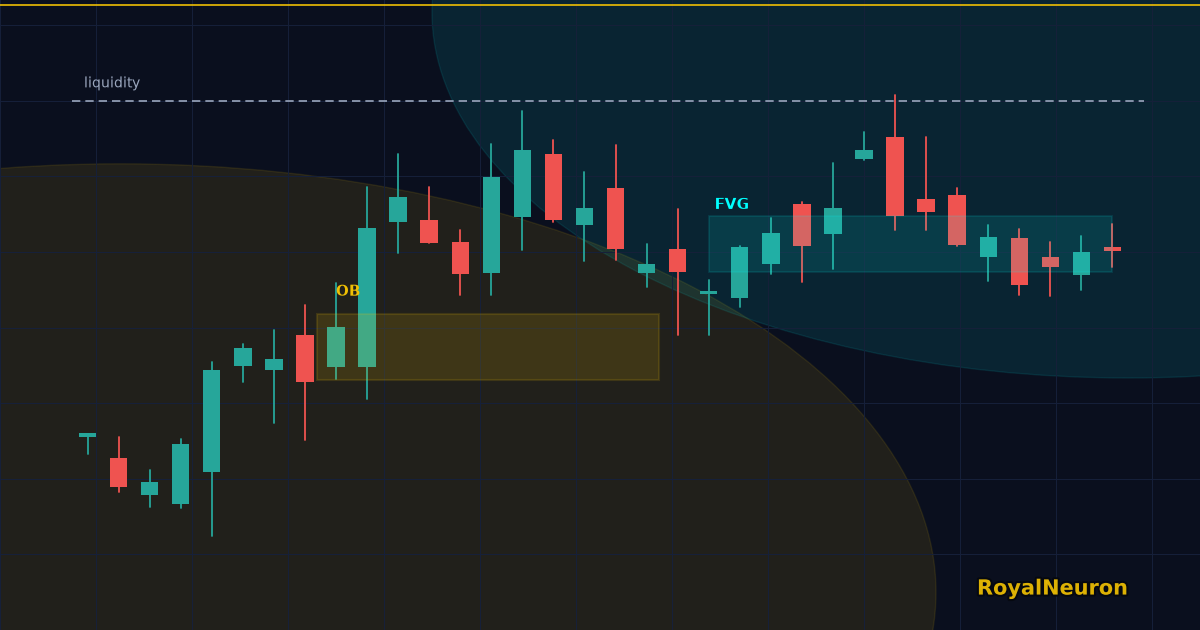
- Order block. The last opposing candle before a strong move, where the big players loaded orders. Price often returns to it.
- Mitigation block. The same idea, just the why. Price returns so an earlier position can be rebalanced.
- Breaker block. A failed order block. When price breaks clean through, the zone flips role, old support becomes resistance and the other way round.
- Fair value gap (FVG). A three-candle imbalance left by a fast move. Often gets revisited and filled. Wait for the close.
- Rejection block. A zone built off the long wicks where price got slammed back. Watch it on the retest.
3. Liquidity
The part that makes SMC click. Stops are fuel, and once you see them the random spikes make sense.
- Liquidity sweep (stop hunt). Price pokes just past an obvious high or low to grab stops, then snaps back. Obvious levels are targets, not walls.
- Buy-side and sell-side liquidity. Stops rest above the highs (buy-side) and below the lows (sell-side).
- Equal highs and lows. Matching tops or bottoms where stops stack up, which makes them a magnet.
- Inducement. The bait, an obvious level set to tempt traders in and build liquidity, right before the real move.
- Liquidity void. An empty patch a fast, one-sided move leaves behind. Price often comes back to rebalance it.
- Draw on liquidity. The magnet, the pool of stops price is most likely being pulled toward next.
4. Where to buy and sell
Once you have structure and zones, this is how you pick your side of the range.
- Premium vs discount. Split a range at 50%. Above is premium (look to sell), below is discount (look to buy). Buy the low half, sell the high half.
- Optimal trade entry (OTE). Draw a fib on the leg. The 62 to 79% retracement is a sensible discount area where smart money often re-enters with the trend.
5. Intent and timing
The tells that a move is real, and when the big moves tend to happen.
- Displacement. A big, decisive candle that shows real intent. It usually leaves a fair value gap behind.
- Power of three (AMD). Accumulation, manipulation, distribution. Build quietly, fake out to grab liquidity, then run the real direction.
- Killzones. The session windows where the big moves cluster, mainly London and New York. The same setup at 3am dead behaves very differently to the New York open.
- Judas swing. A false move early that traps traders, then reverses sharply the other way. If it feels too obvious, be patient.
Putting it together
You don't need all of it at once. Most days it's three steps, read structure (BOS / CHoCH), mark the zone price reacted from (an order block or FVG), then watch how price behaves around the obvious liquidity. Wait for the candle to close before you trust anything. The rest is reps.
I build clean, non-repainting tools around these ideas. They're free and open-source on TradingView, grab them here. Use them, break them, tell me what you'd change.
Cheers, RoyalNeuron 👑
Not financial advice. Educational only. Trading involves risk.